If you’re a U.S. farmer asking yourself, “What is revenue protection crop insurance?”, you’re already on the right track to protecting your operation from one of the biggest risks in modern agriculture: volatile commodity prices combined with unpredictable yields. Revenue Protection (RP) is the most popular federally subsidized crop insurance policy in the United States, covering millions of acres from the Corn Belt to the Texas Panhandle. In this in-depth 2025 guide, we’ll explain exactly what revenue protection crop insurance is, how it works, why it’s often better than traditional yield-based plans, real payout examples, current premium costs, and what to do if your RP claim gets denied or underpaid.
In 2024 alone, Revenue Protection policies paid out over $9.8 billion in indemnities according to the USDA Risk Management Agency (RMA), proving that understanding what is revenue protection crop insurance can literally be the difference between staying in business or closing the farm gate forever.
The Basics: What Is Revenue Protection Crop Insurance Exactly?
Revenue Protection (RP) is a federal crop insurance product that guarantees a certain level of revenue per acre rather than just bushels or pounds. It protects you against three major risks:
- Low yields caused by drought, hail, wind, flood, or other insured perils
- Falling crop prices after planting
- A combination of both low yield and low prices (the worst-case scenario)
Unlike older Yield Protection (YP) plans that only pay when your actual production falls below your guaranteed yield, RP steps in whenever your harvested revenue (yield × harvest price) drops below your revenue guarantee — even if your yield is normal but prices crash.
Think of it this way: RP is like having a financial safety net that catches both production disasters and market disasters.
How Revenue Protection Crop Insurance Actually Works (2025 Rules)
Let’s walk through a real-world example using 2025 projected prices and a Midwest corn farmer:
- Historical Yield (APH): 200 bushels per acre
- Coverage Level Chosen: 85% (the most popular level)
- Projected Price (set in February): $4.80 per bushel
- Revenue Guarantee: 200 bu × $4.80 × 85% = $816 per acre
During harvest, the RMA determines the Harvest Price. Let’s look at three different scenarios:
Scenario A – Good Year
Actual yield: 210 bu/acre
Harvest price: $5.20
Actual revenue: $1,092/acre → No payment (above guarantee)
Scenario B – Drought + Normal Prices
Actual yield: 120 bu/acre
Harvest price: $4.90
Actual revenue: $588/acre → Payment = $816 – $588 = $228/acre
Scenario C – Normal Yield + Price Collapse
Actual yield: 195 bu/acre
Harvest price: $3.60
Actual revenue: $702/acre → Payment = $816 – $702 = $114/acre
This price protection is the key difference that makes farmers ask “what is revenue protection crop insurance?” — because traditional yield insurance would have paid nothing in Scenario C.
Revenue Protection vs Yield Protection vs Area-Based Plans (2025 Comparison)
| Feature | Revenue Protection (RP) | Yield Protection (YP) | Revenue Protection with Harvest Price Exclusion (RP-HPE) |
|---|---|---|---|
| Protects against low yields | Yes | Yes | Yes |
| Protects against falling prices | Yes | No | No |
| Uses higher of projected or harvest price | Yes | No | No |
| Most popular in Corn Belt | 88% of insured acres | 8% | 4% |
| Average 2025 subsidy | 59% of premium | 59% of premium | 59% of premium |
Source: USDA RMA 2025 Summary of Business
Current 2025 Projected Prices and Volatility Factors
As of February 2025 (Discovery Period):
- Corn: $4.80/bushel
- Soybeans: $11.20/bushel
- Wheat: $7.10/bushel
- Cotton: $0.78/lb
These prices set your initial revenue guarantee. The Harvest Price is determined in October/November using the same methodology.
Who Should Buy Revenue Protection Crop Insurance?
RP is ideal for:
- Farmers in regions with volatile prices (Corn Belt, Plains states)
- Operations with high fixed costs or significant debt
- Younger farmers building equity
- Anyone who forward-contracted grain and wants to lock in protection
Even organic farmers can purchase Revenue Protection — organic corn projected price for 2025 is $11.50/bushel.
How Much Does Revenue Protection Cost in 2025?
Premiums vary by county, coverage level, and farming practices, but here are national averages for an 85% coverage level on corn:
| State | Farmer-Paid Premium ($/acre) | Total Premium ($/acre) | Federal Subsidy |
|---|---|---|---|
| Iowa | $24–$32 | $62–$78 | 61% |
| Illinois | $28–$38 | $70–$90 | 60% |
| Nebraska | $22–$30 | $55–$72 | 62% |
| Texas | $35–$50 | $90–$120 | 59% |
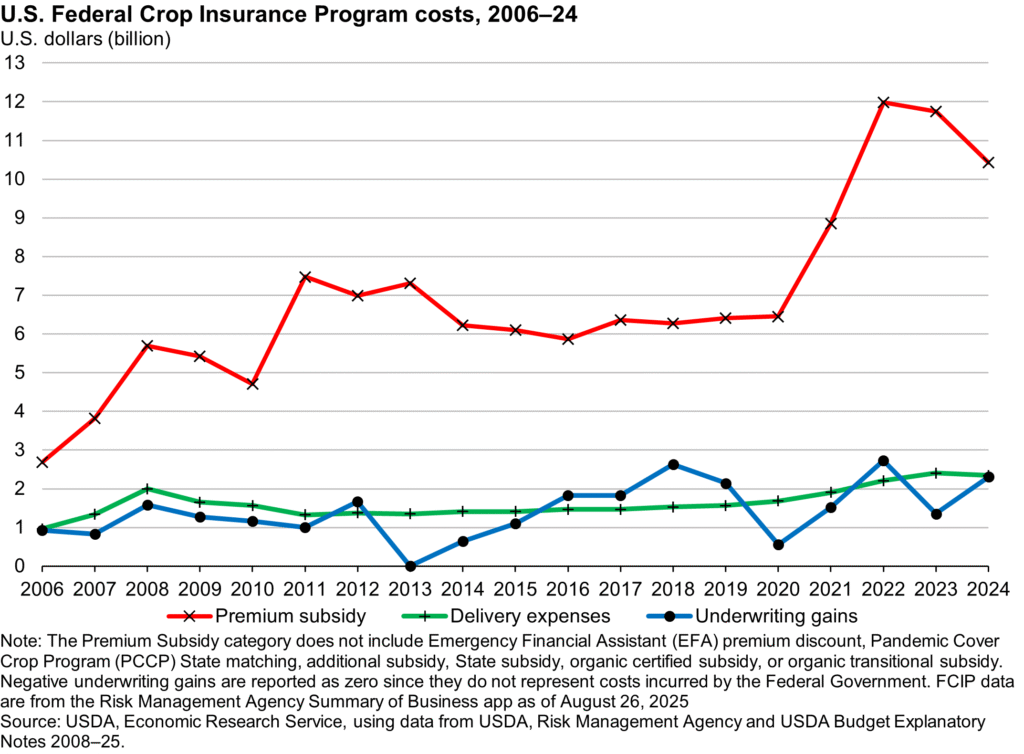
The federal government pays 59–62% of the total premium depending on coverage level — one of the best deals in American agriculture.
Common Misconceptions About Revenue Protection
- “I don’t need RP because I forward contract” → Wrong. Forward contracts lock price but not yield.
- “RP only pays in drought years” → False. It paid billions in 2019 when prices collapsed.
- “It’s too complicated” → Your agent does 95% of the work.
Real 2024 Payout Examples
- Central Illinois corn farmer: 180 bu yield × $3.40 harvest price = $612 revenue vs $864 guarantee → $252/acre indemnity
- North Dakota wheat farmer: 38 bu yield × $8.50 price = $323 revenue vs $480 guarantee → $157/acre payment
- Kansas sorghum operation: Normal yield but price dropped from $6.80 to $4.90 → $190/acre payment despite good production
What to Do If Your Revenue Protection Claim Is Denied or Underpaid
Unfortunately, disputes happen. Common issues:
- APH disagreements
- Prevented planting denials
- Production reporting errors
- Good farming practice disputes
If you’re facing a denied or short-paid RP claim, contact an experienced agricultural attorney immediately. Here are four highly respected U.S. firms specializing in Revenue Protection disputes:
Watts Guerra LLP (Nationwide, headquarters Texas)
One of the largest ag litigation firms in America. They’ve recovered hundreds of millions for farmers in RP and prevented planting cases.
Website: wattsguerra.com/agriculture
McLeod, Alexander, Powel & Apffel (Galveston, TX)
Known for handling complex Revenue Protection arbitration nationwide.
Website: mapalaw.com
Faegre Drinker Biddle & Reath LLP (Midwest offices)
Former USDA attorneys now representing farmers against insurance companies.
Website: faegredrinker.com
Stewart Law Firm, PLLC (Kansas City metro)
Attorney Grant Stewart specializes in RMA arbitration and federal court appeals for RP claims.
Website: stewartlawkc.com
New 2025 Revenue Protection Enhancements
The RMA introduced several farmer-friendly changes:
- Higher organic price elections
- Expanded Enterprise Unit discounts
- New “Trend-Adjusted APH” options in more counties
- Enhanced Coverage Endorsement (ECO) now available up to 95%
Is Revenue Protection Worth It? The Numbers Don’t Lie
Since 2015, Revenue Protection has paid out $68+ billion in indemnities while farmers paid roughly $24 billion in premiums — a 2.8-to-1 return on their premium dollar.
Secure Your Farm’s Revenue Today
Now that you understand what revenue protection crop insurance is, the real question becomes: Can you afford to farm without it?With commodity prices more volatile than ever and weather patterns growing extreme, Revenue Protection isn’t just insurance — it’s risk management that lets you sleep at night knowing your revenue is protected no matter what Mother Nature or the markets throw at you.Talk to your crop insurance agent before the March 15, 2025 sales closing date for spring crops. Your future self (and your lender) will thank you.
📚 You May Also Like
💡Understanding the Crop Insurance Claims Process for Drought Damage in the USA
Learn which US-based attorneys provide the strongest legal representation and highest claim success rates this year.
🚗 Affordable Livestock Insurance Quotes November: Complete 2025 Guide for U.S. Farmers & Ranch Owners
Explore top-rated US attorneys helping victims maximize compensation for Livestock damage and medical expenses.
⚖️How Much Does Farm Insurance Cost for Small Ranches? (2025 Complete U.S. Guide)
Discover the pros and cons of managing your Crop insurance claim independently versus hiring a legal expert.
🔥 Best Crop Insurance for Corn Farmers 2025: Complete U.S. Guide to Maximize Protection & Profitability
See how US ranks and what factors drive up insurance rates across the country.